WETTERVORHERSAGE → QUNZRGCLEGFTZRBBBletchley Park had a guess. Turing's machine had 17,576 positions to try.
The Enigma and Turing's codebreaking machine, working in your browser
An Enigma I you can type on, and the Turing–Welchman machine that breaks its key from one guessed word, both running in your browser.
- 3 rotors
- 10 plugs
- 158 million million million keys
- 108 drums
- 17,576 positions
- 2 stops
Encipher
The Enigma
Press a key: the rotors step, then current runs through the plugboard, three rotors and the reflector, and back to a lamp.
What the marks mean
- Lit in turn: key, plugs, cable, wheels, rotor contacts, lamp
- Three rotors from five; the pawls step them before the contacts close
- The wiring diagram: the same path, letter by letter, out and back
Set the day's key · 158 million million million of them
That is the key space of the Enigma I quoted at the top, counted the way Wikipedia's Enigma machine article counts it: 60 ways to put three of the five rotors in order, × 17,576 start positions, × 150,738,274,937,250 ways to plug ten pairs (26! ⁄ (6! × 10! × 210)) = 158,962,555,217,826,360,000.
That count leaves the ring settings out. The left ring only renames the window, but the middle and right rings move where the turnovers fall, so counting their 26 × 26 = 676 settings too gives 107,458,687,327,250,619,360,000, about 1.07 × 10²³. Either way, too many to try one by one: the machine never tries plugboards at all.
Intercept
The message
191 letters in five-letter groups. The guess, a crib: it begins WETTERVORHERSAGE, weather forecast.
- QUNZR
- GCLEG
- FTZRB
- BDMGH
- QXZKC
- PUARJ
- CWHSJ
- WDZXF
- KTJBQ
- EKMAI
- RZRZV
- BNVVQ
- SNVOC
- HRINB
- ZZCJG
- NTFAZ
- PXCMA
- LUBNT
- FPJEL
- IZJVM
- WUCRT
- DJTNC
- MZKXS
- IBJSG
- IHKMY
- DLSVB
- WHKUX
- HWJPM
- KBZVB
- ODMIU
- POSSQ
- BYRAZ
- BOEKN
- PPCRM
- LOFKB
- ULYQY
- OHZCF
- FWAPI
- E
- Cipher
- QUNZRGCLEGFTZRBB
- Crib
- WETTERVORHERSAGE
More: where this message comes from
The message, the key and the crib are this page's own, made in the style of the real ones: a weather report enciphered on an Enigma I with wheel order II-V-III, reflector B, rings BUL, start RKX and ten plug pairs. The model enciphers it here with the same code that drives the figure.
A crib is, in the words of Wikipedia's article on the British codebreaking machine, "a section of plaintext that was thought to correspond to the ciphertext". The first four groups, in amber, are the crib's sixteen letters enciphered.
Search
Turing's codebreaking machine
Thirteen scramblers wired as the menu turn together through 17,576 positions, and stop only where the menu holds.
At a stop one lamp is lit, or all but one.
What the marks mean
- The test register's lamps: the wires live on the central letter's bus; one lit, or all but one, is a stop
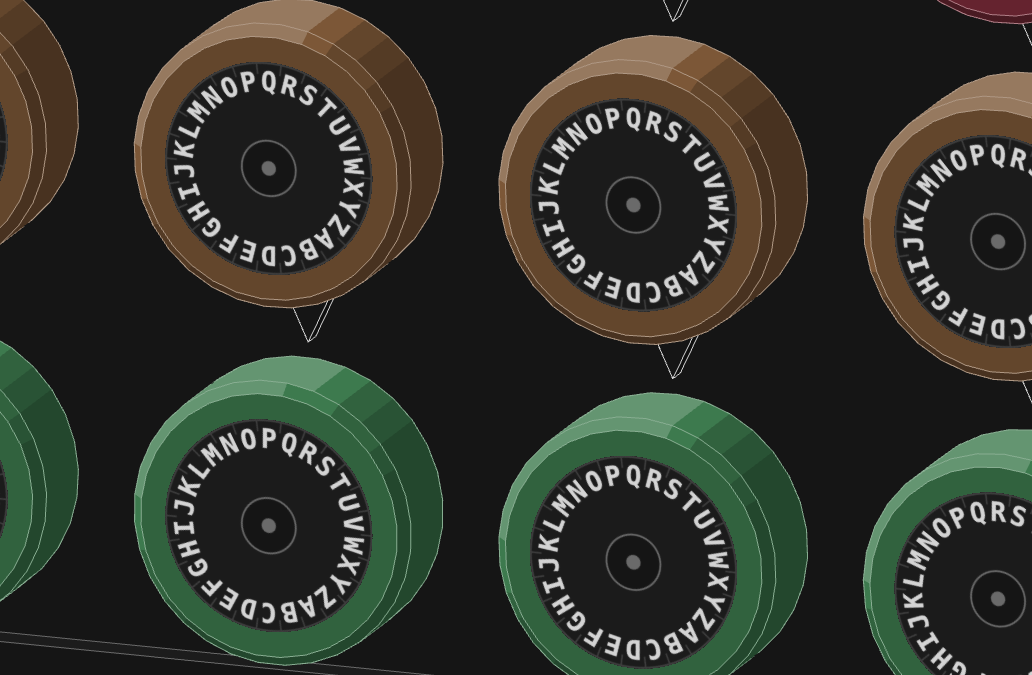
- 108 drums, 36 Enigma scramblers: top II maroon (left rotor, the fast drum), middle V brown, bottom III green; 13 are wired to the menu
- The menu on the side plate: letters joined by crib positions; its two loops (bright) are what make a stop rare
- The open bay: the motor's belt drive, and on the back the scrambler jacks cabled to the diagonal board
More: the run in numbers and the stops
On this job the sweep stops twice. At DBC 25 of the test register's 26 lamps light: every hypothesis but one is contradicted, so the machine proposes E plugged to M. At QQM one lamp lights: E plugged to E, that is, unplugged. QQM is the message's true starting position less its ring settings (window RKX less rings BUL).
Gordon Welchman's diagonal board joins every "X is plugged to y" wire to its mirror, "y is plugged to X", because plugs work both ways. With it the sweep stops 2 times; without it, as Turing's 1939 design ran, 707 times. Across all 60 wheel orders it is 66 stops against 40,897, and one survives the checking machine.
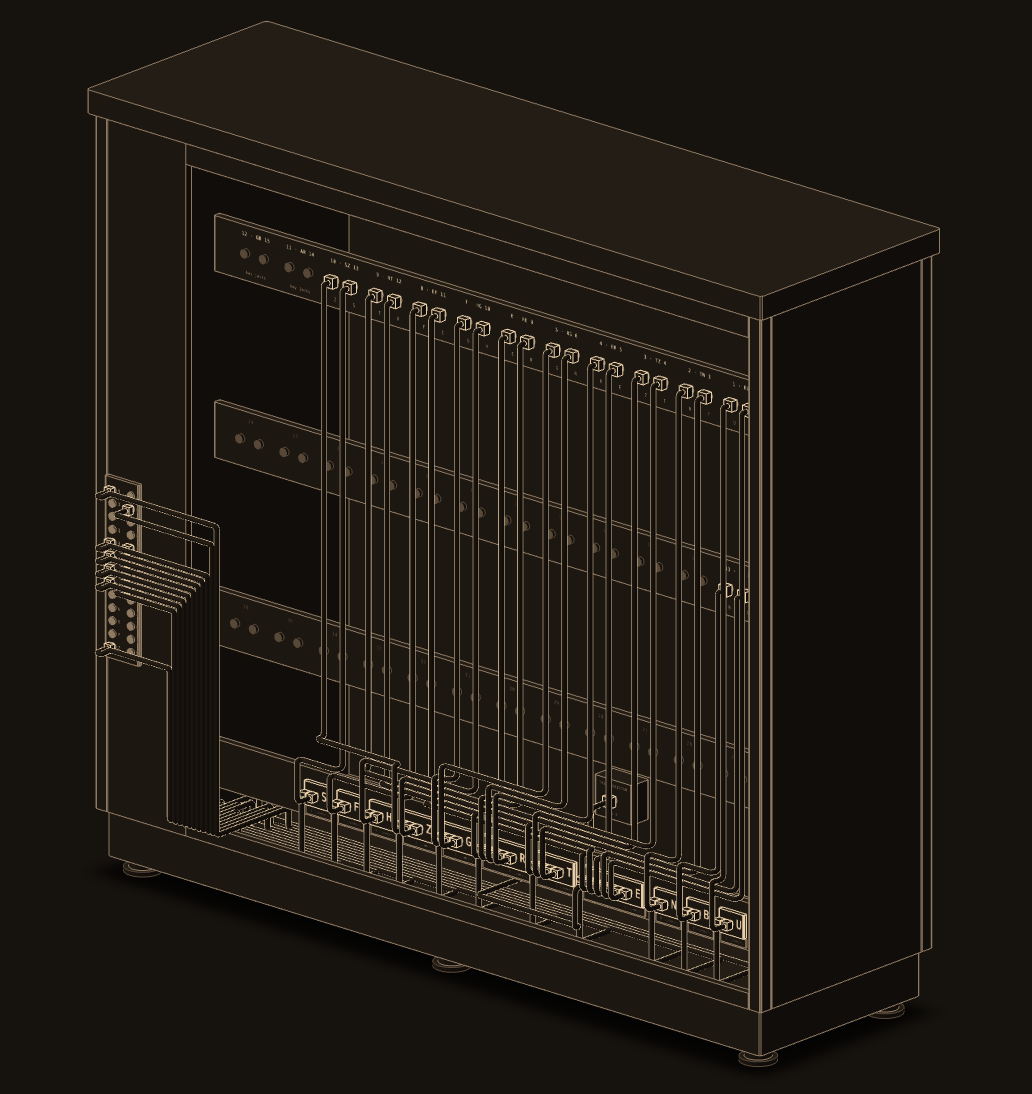
On the real machine the menu was plugged at the back. The 3D view opens it: each wired scrambler's two jacks cabled to its letters, each letter to the diagonal board (the still in the history section).
Read
The answer
A stop is a candidate. The checking step throws out the false one and finds the plugs.
At DBC, following the menu from E–M forces two plugs onto B: rejected. QQM holds, and the menu gives seven pairs. Reading the rest as German finds the ring settings and the last three.
- AV
- BS
- CG
- DL
- FU
- HZ
- IN
- KM
- OW
- RX
More: the checking step
The machine only knew that a position did not contradict itself. Hut 6 took each stop and followed the menu from the proposed plug: if E goes to M, each join forces a partner for the next letter. At DBC the model finds "B forced to W but already Z" and the stop is thrown out.
At QQM every join agrees. The menu yields AV BS CG FU HZ IN RX (outlined above), with E and T unplugged: 16 letters known. The rest comes from reading. The page tries the 676 middle and right ring settings and each further pair, keeping whatever makes the text read more like German by letter-pair statistics (a stand-in for the Hut 6 reader). It finds rings AAL, start QQX, and the plugs DL KM OW.
Press Decrypt and the browser does all of it again from the intercept and the crib: the menu, the sweep, the checking step and the reading, then the message.
History
The real machines
Designed by Alan Turing in 1939, improved by Gordon Welchman, built at Letchworth.
- Alan Turing designs the machine
- Victory, built by BTM under Harold Keen, installed in Hut 1
- Agnus Dei, with Welchman's diagonal board
- By 1945211 machines; 1,676 Wrens and 263 RAF involved
- 1994–2007Rebuilt by John Harper's team; now at The National Museum of Computing
More: the machines and the people
Alan Turing produced the first design in 1939, for the machine known at Bletchley Park as the bombe. The British Tabulating Machine Company at Letchworth built the machines, with Harold "Doc" Keen in charge of the engineering. The first, Victory, was installed in Hut 1 on 18 March 1940, without a diagonal board (Wikipedia; The National Museum of Computing gives 14 March 1940 for the day it started code-breaking). The second, Agnus Dei, "was equipped with Welchman's diagonal board, and was installed on 8 August 1940" (Wikipedia).
Bletchley Park says it plainly: "Hundreds of the machines were operated by Wrens", the Women's Royal Naval Service, on long shifts. Hut 11B was where Wren operators were trained. By the end of the war, The National Museum of Computing records, 1,676 WRNS and 263 RAF personnel were involved in running 211 machines.
Each machine was about 7 ft wide, 6 ft 6 in tall and 2 ft deep and weighed about a ton. The fast drums turned at 50.4 rpm on the first machines and 120 rpm on later ones; the figure runs at 120 rpm, so a full sweep takes 5.6 minutes.
The rebuild: from 1994 a team led by John Harper, under the BCS Computer Conservation Society, reconstructed a Turing–Welchman machine at Bletchley Park. The museum's page records the steel frame installed in Hut 11 in September 1997, commissioning in 2006/7 and an official unveiling by the Duke of Kent in July 2007; Wikipedia gives 17 July 2008 for the switch-on. It is now shown at The National Museum of Computing, where it moved in 2018.
Honesty
Faithful and simplified
The ciphers and the search are real. The message, and some of the drawing, are the page's own.
As the machines worked
- Rotors I–V, reflectors, double step
- 108 drums, colour-coded
- Menu, test register, diagonal board
- All 17,576 positions, 120 rpm
This page's own
- The message, key and crib
- No turnover inside the crib
- Stops halt at once
- The open bay; the rotors shown
The full list
As the machines worked
- Enigma I: rotors I–V with their real wiring and notches, reflectors A, B and C, the entry wheel, ten plugs, and the stepping with its double step; checked against published test vectors (I-II-III, B, rings AAA, start AAA: AAAAA → BDZGO) and a worked message from the German Wikipedia.
- Pressing a key steps the rotors first, then closes the circuit.
- Turing's machine: 108 drums in three banks of twelve triplets, 36 Enigma scramblers, colour-coded I red, II maroon, III green, IV yellow, V brown; the top drum stands for the left rotor and turns fastest.
- The menu from a crib, the crash rule, the test register on the central letter, a stop at 1 or 25 live wires, and Welchman's diagonal board.
- All 26 × 26 × 26 = 17,576 positions per wheel order, at 120 rpm.
This page's own
- The weather report, the day's key and the crib are made for this page, not a historical intercept.
- A stop is a core position: the machine knows nothing of ring settings, and Hut 6 found those afterwards.
- The menu assumes no middle-rotor turnover inside the crib; a crib that straddles one is not found.
- The real machine over-ran a stop and backed up to it; here it halts at once.
- The checking step reads German by letter-pair statistics, standing in for the Hut 6 reader, and the browser runs only the right wheel order (the whole job is 60 orders; the page computes it before publishing).
- The Enigma's rotor bay is drawn open with the windows on a strip; on the machine an inner lid covers the rotors.
- The machine's open bay, its motor, belt and guard are an illustration; on the real machine the jacks and the diagonal board are at the back. The 3D view's cable routes are tidy lanes, not a wiring drawing.
Making
How it was built
Nothing here is drawn by hand.
- 525solids
- 0floating line ends
- 48model checks
- 3models
Both figures are isometric SVGs written by build scripts with the open-source Anatomy skill for Claude Code. Three small models, one for the Enigma, one for the search and one for reading German, drive the drawings, the 3D view and the decrypt.
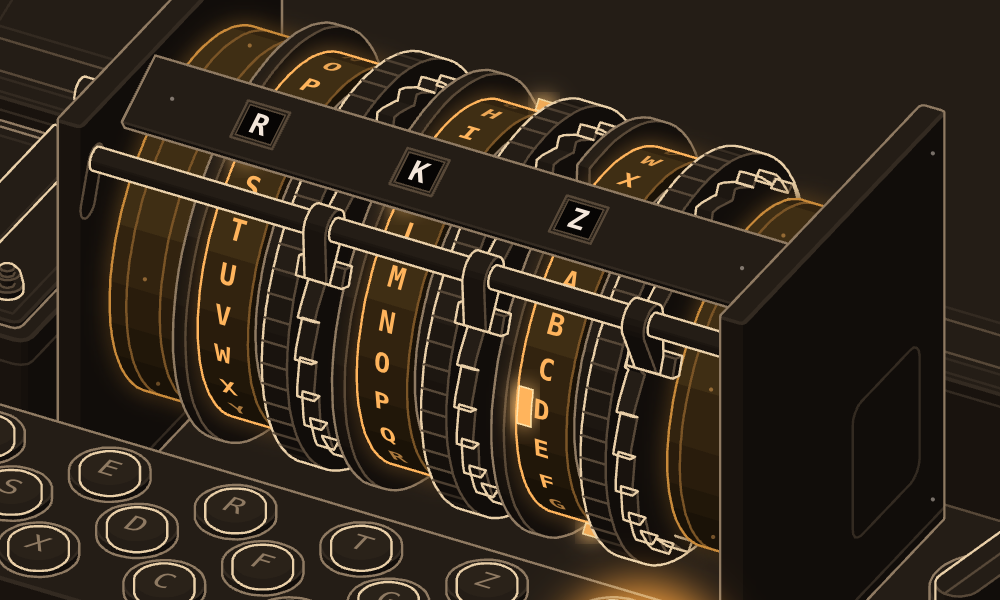
More: the audit and the checks
- Enigma: 165 solids · 10 tubes · 3 resting states audited · 3,613 overlaps against 1,215 order rules
- Turing's machine: 360 solids · 6 tubes · 5 resting states · 3,040 overlaps against 608 order rules
- 21 Enigma checks · 27 search checks, all passing
Every part is a small solid with four-tone shading, and the build records what it draws. The audit passes when nothing passes through anything, nothing is painted out of order and every fine line ends on something.
The Enigma model is the machine: wiring, stepping, the lamp path. The search model is the rest: the menu, the test at one position with union–find over 676 wires, the sweep, the checking step and the reading. They are tested end to end: encipher the report, build the menu, run the sweep, check the stops, recover the ten plugs and read the message back exactly.
The 3D view is three.js, built from the SVG figure's layout and posed every frame by the same model. Glow mode follows April Zhu's iso-glow.
Credits
Sources and credits
History from Wikipedia, The National Museum of Computing and Bletchley Park; the wiring from Wikipedia's rotor table.
The sources
- Wikipedia: the British codebreaking machine: the design, the drums and their colour code, the speeds and size, Victory and Agnus Dei, BTM and Harold Keen, the diagonal board, cribs, crashes and stops, and the rebuild.
- Enigma rotor details, Wikipedia, which cites the Crypto Museum: rotor and reflector wiring, notches, the double step and the test vectors.
- Enigma (Maschine), German Wikipedia: the worked message the model is checked against, and the German text the letter-pair statistics come from.
- Enigma machine, Wikipedia: the key-space count.
- The National Museum of Computing: the Turing–Welchman machine: the rebuild, and the WRNS and RAF numbers.
- Bletchley Park: six facts about the machine: the Wrens who operated the machines, and Hut 11.
Built by Kevin Owens with Claude Code. Figures with Anatomy by wheresryan22 (MIT); glow mode after iso-glow by April Zhu (MIT); 3D view with three.js (MIT), vendored so the page loads nothing off-site.
Licences: Anatomy · three.js · Enigma alone · The machine alone · 3D view
If you know the real machines and see something wrong here, tell me. Corrections are credited.